Tiny Reader
The anti-brain rot keychain.
Scrolling is addictive
Social media and instant messaging started as fun ways to connect with friends, but they all had something that’s long gone: logging in and out.
There are so many reasons to pick up a phone and mindlessly proceed down the infinite scrolling rabbit hole. Stress, anxiety, and boredom come to mind.
Boredom. This is something I’ve always had a hard time differentiating from so many other feelings. Which means I usually end up trying to get rid of it with something else. It wasn’t always like this, but at some point, the default choice became scrolling.
Replacing the habit
While I enjoy the idea of learning when to embrace boredom, I know the solution that would work to me was to try to utilise the impulse to my advantage. If I will reach out to something, let me consciously define what that something is.
For it to work, it had to be something as convenient, if not more, as opening my phone and scrolling away. Which is not an easy feat – the impulse to reach my right hand down my pocket and look at the screen for Face ID to unlock is baked into my brain. I have a strong muscle memory of swiping down on the home screen and typing the first 1-2 characters of whatever social app onto Spotlight.
But I know how to make things! I enjoy making them!
A purpose built device
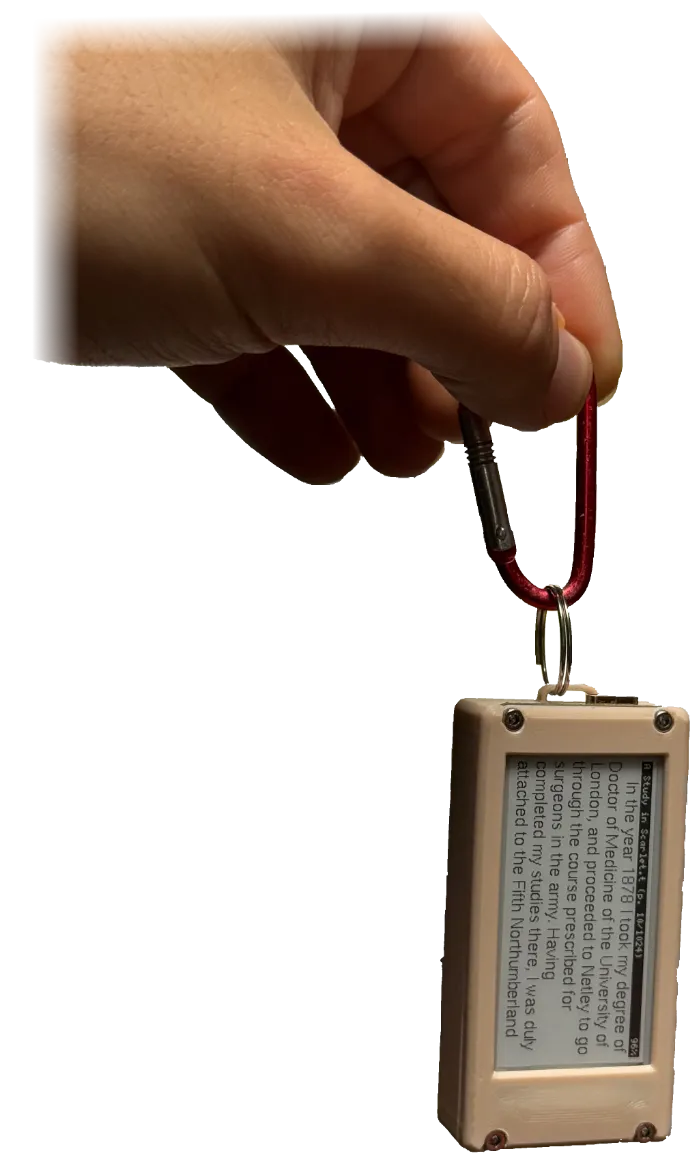
Inspired by similar projects I found on YouTube, I set out to build a device that would work for me. Tiny Reader was born.
Tiny Reader is an e-ink book reader. Like a Kindle, but tiny – with a 2.13 inches display, and attached to a small carabiner that clips onto my belt loop, or to my keys.
It’s only user interface are its non-touch screen and a single button. One press goes to the next page, two presses goes back a page. 99% of the time, that’s all there is to it.
Three presses opens a book selection menu (it can hold multiple books!), and four presses opens a dialog to skip to a specific page.
How to get books into it? That’s where the final user interaction capability comes in: five presses makes the device create a Wi-Fi network that you can connect to and navigate to a web page with a file upload form and a list of stored books.
Books can be loaded as TXT files (with some basic Markdown formatting accepted). These are easy to prepare thanks to Calibre’s ebook conversion feature.
How it was made
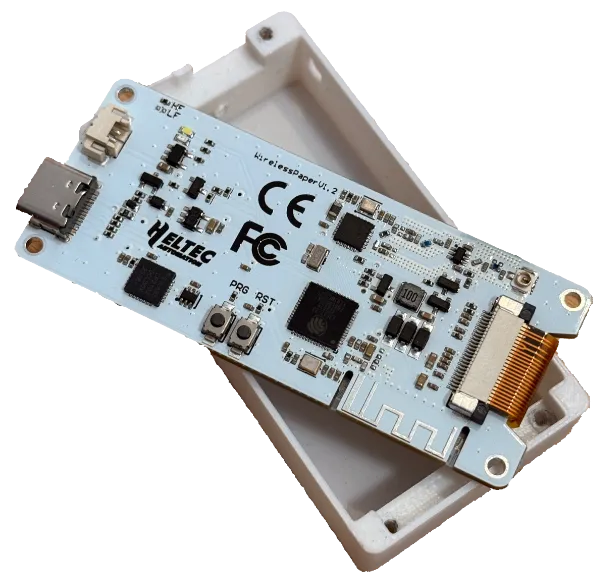
Tiny Reader is based on a Heltec Wireless Paper board, which includes the e-ink screen, the ESP-32 chip, a USB-C port, charging circuitry, and a user-programmable button.
The two other components used are a 3.7 volt 2000 mAh battery and a push button that I soldered onto the pads of the original button embedded on the board, so I can have it on a more accessible location.
Everything is held together by a 3D printed case, secured with M2 screws.
The software makes heavy use of the ESP-32 board multiple sleep modes. By being aggressive with power management, I’ve been able to squeeze many weeks of battery life. The device is only consuming significant power while transitioning between pages or running the upload web server.
It keeps track of your current position on the book automatically, and it has no user-controllable power on or off. It is always ready. That’s even more convenient than my phone which I have to unlock.
Reconnecting with reading
I’ve always loved reading. As a child and a teenager, I’d spend hours on a book, sometimes late into the night when I was supposed to be sleeping.
Then came the adult life, and I slowly drifted away from this habit. Now I’m always connected, never offline.
Tiny Reader resurfaced my desire to read books. Having it with me on the bus, on the train, when waiting at the dentist’s reception, means I’m reading instead of scrolling.
I still cannot fully embrace boredom, and that’s ok. I’m happy with the replacement.
The best part is this I’m not limited to reading on Tiny Reader. I have other e-ink devices, which are more or less convenient depending on the occasion, and I use them more now. Oh, and also: books, physical ones. I have some of these too!
Go build stuff
Tiny Reader was the spark I needed to get back into the habit. I built it as a fun project, and it ended up being much more than that.
This only happened because I like building things. Many of the projects I start are never finished. Some are and you’re reading about them in this website.
For every project I build, the worst case scenario is that I learn something. That’s the baseline outcome, every time.
And some of them nudged me towards being happier. This was one of them.
So go build stuff!